Building a More Modern Grant Management System
Grant management sits at the beating heart of any organization that depends on external funding to fulfill its mission. Without it functioning smoothly, even the most well-run businesses and nonprofits stall — delayed by paperwork, compliance missteps, and the slow erosion of funder confidence. Yet despite the undeniable importance of the function, many organizations are still running it on infrastructure that belongs in a different decade.
The reasons are understandable. Legacy systems persist because replacing them feels risky, expensive, and disruptive. Spreadsheets stick around because everyone already knows how to use them. But the costs of inaction are mounting. As grant portfolios grow more complex and funder expectations rise, organizations that cling to outdated methods find themselves increasingly outpaced by peers who have embraced modern solutions.
Modernizing grant management is not simply a technology upgrade — it is a strategic investment in the integrity, efficiency, and long-term credibility of your organization.
The weight of outdated systems
The challenges facing traditional grant management are not abstract. They show up every day in the form of duplicated effort, missed deadlines, and frantic last-minute reporting scrambles. To understand why modernization matters, it helps to look closely at where legacy approaches break down.
The most pervasive problem is the continued reliance on paper-based workflows and homegrown digital systems that were never designed to scale. Routing a grant application through a chain of email approvals might have worked reasonably well when an organization was managing a handful of awards. But multiply that across dozens of concurrent grants — each with its own deadlines, reporting requirements, and compliance conditions — and the cracks become chasms.
Manual data entry compounds the problem. Every time a number is typed by hand into a spreadsheet, there is a chance it is wrong. Every time a file is downloaded, modified, and re-uploaded, there is a chance the version someone else is looking at is already out of date. These are not hypothetical risks; they are the ordinary friction of systems built before cloud collaboration existed.
Information silos are another critical failure point. When different teams — program managers, finance offices, compliance staff, and external funders — are working from disconnected systems, coordination becomes expensive. Decisions get made on the basis of incomplete information. Communications fall through the gaps. And when something goes wrong, tracing the root cause can take longer than fixing it.
The cumulative effect of these issues is a slower, more error-prone process that strains the people responsible for running it. Grant managers, already stretched thin, spend disproportionate time on low-value administrative tasks instead of the strategic work that actually advances organizational goals. And funders, lacking visibility into how their money is being managed, grow understandably cautious.
Why modernization is no longer optional
The competitive dynamics of grant funding have changed. Funders — whether federal agencies, private foundations, or corporate giving programs — are more sophisticated than ever in their expectations. They want real-time visibility into how grants are progressing. They want clean, auditable financial records. And they want the organizations they fund to demonstrate that they are managing complexity with competence.
📈
BENEFIT
Transparency and accountability for every stakeholder
👥
BENEFIT
Real-time collaboration across teams and partners
⚡
BENEFIT
Automated workflows that eliminate bottlenecks
📊
BENEFIT
Data-driven decisions backed by live analytics
Organizations that can demonstrate strong grant management practices stand out. They win more awards, retain funders across grant cycles, and build the kind of institutional reputation that opens doors to larger and more complex funding opportunities. Conversely, organizations that cannot demonstrate these capabilities increasingly find themselves at a disadvantage — not because their programs are weaker, but because their administration signals risk.
Beyond the competitive dimension, there is a straightforward operational case for modernization. Better grant management means fewer errors, fewer compliance violations, and fewer costly course-corrections mid-project. It means staff who are less burned out and more effective. And it means program teams who spend more time delivering impact rather than managing paperwork.
“The organizations that thrive will be those that treat grant management not as an administrative burden, but as a core competency.”
The technology driving the shift
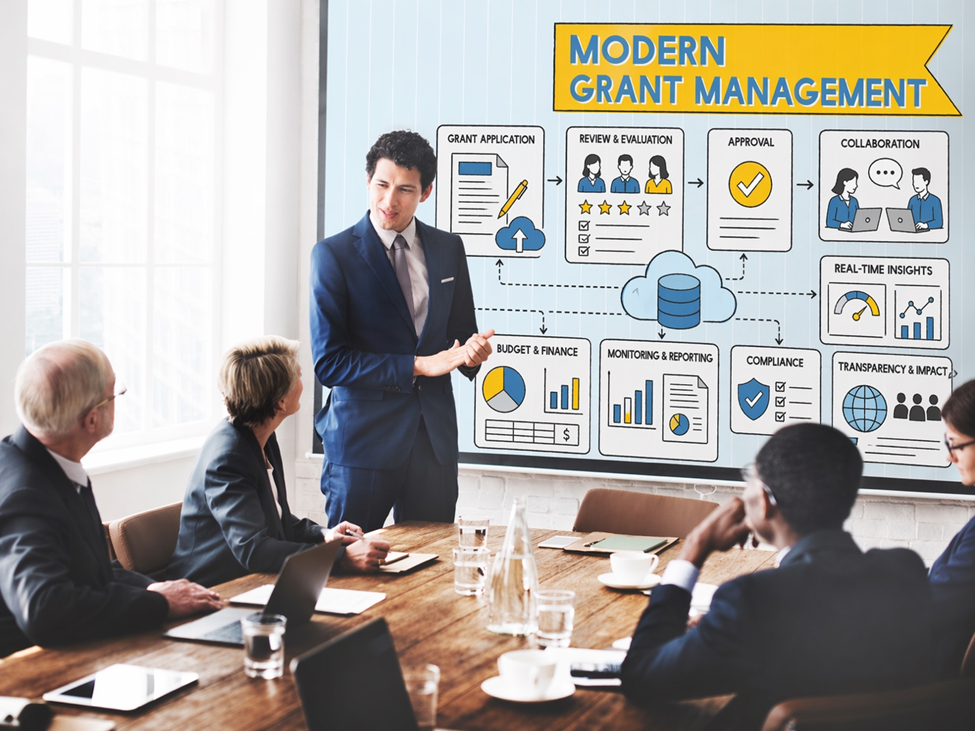
Modern grant management solutions are built around a few foundational capabilities that directly address the shortcomings of legacy approaches. Chief among them is cloud-based centralization.
Moving grant management to the cloud creates a single source of truth for every active grant. Program managers, administrators, reviewers, and funders all access the same information, in real time, from wherever they happen to be. The version control headaches that plague local file systems disappear. The email chains carrying outdated attachments become unnecessary. And the risk of someone making a consequential decision based on stale data drops sharply.
Automation is the second transformative lever. Modern platforms can handle the repetitive, rule-based tasks that consume so much staff time — things like deadline reminders, approval routing, budget tracking, and compliance flag generation. When these tasks run automatically, grant managers get time back. They can redirect that time toward higher-judgment work: building funder relationships, identifying potential compliance issues before they become violations, and helping program teams navigate the complexities of multi-grant portfolios.
Real-time data collection and analytics round out the picture. When grant activity is tracked systematically and continuously, organizations gain a live view of their entire funding portfolio. They can see which grants are on track, which are running behind, and where resources may need to be reallocated. Over time, this data also enables something more powerful: pattern recognition. Organizations can begin to understand which program types tend to run over budget, which compliance categories generate the most issues, and how to structure future grant applications for better outcomes.
Building trust through better reporting
Reporting is where the relationship between an organization and its funders becomes most tangible. And it is an area where the gap between legacy and modern approaches is especially stark.
With traditional methods, generating a funder report is often a labor-intensive exercise in data gathering, reconciliation, and formatting. Information lives in different systems — or no system at all — and has to be manually assembled into a coherent narrative. The process is slow, error-prone, and often stressful for the staff responsible for it.
Modern platforms automate much of this work. Because data is being collected continuously and systematically, reports can be generated quickly and accurately, with full audit trails that demonstrate exactly where funds went and what was accomplished. This capability does more than save time — it fundamentally changes the nature of the funder relationship. When an organization can consistently produce clear, accurate, and timely reports, it signals something important: that it is the kind of partner a funder can trust with increasingly significant resources.
Making the transition
Modernizing grant management is not a switch that gets flipped overnight. It requires careful planning, stakeholder buy-in, and a willingness to invest in both technology and the training needed to use it well. Organizations should expect a transition period during which old and new systems run in parallel, and should plan for the change management work that accompanies any significant shift in how people do their jobs.
The key is to approach the transition as a strategic initiative rather than an IT project. The goal is not simply to replace one set of tools with another — it is to fundamentally improve how the organization manages one of its most important functions. That framing changes what success looks like, and it changes who needs to be involved in making it happen.
Grant managers, program directors, finance teams, compliance officers, and organizational leadership all have a stake in how grant management works. Bringing them into the process early — surfacing their pain points, understanding their workflows, and getting their input on what a better system should look like — is essential to an implementation that sticks.
The bigger picture
At its core, grant management modernization is about more than efficiency. It is about building the operational foundation that businesses and nonprofits need to do their most important work: delivering programs, serving communities, and creating lasting impact.
That mission is hard enough without administrative friction holding it back. When grant management works the way it should — transparently, efficiently, and collaboratively — program teams can focus on delivery. Administrators can focus on adding strategic value. And funders can invest with confidence. That alignment of effort and trust is what modern grant management makes possible.
The organizations that recognize this — and act on it — will be better positioned to attract funding, retain staff, and sustain the kind of impact-driven work that endures well into the future.